





Common Weaknesses in Employee Employment Claims: What Employers Should Look For


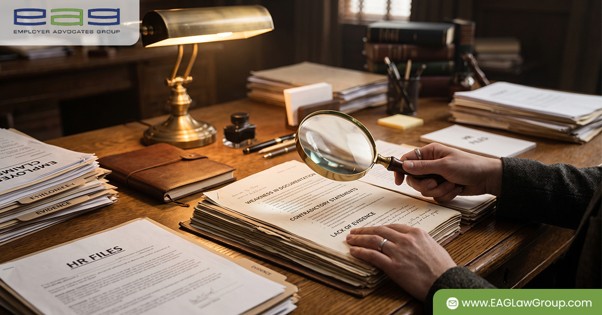
Employee claims land on an employer’s desk without warning. A letter shows up. A lawsuit gets filed. Panic sets in fast. But not every claim holds up under a close look. Some claims carry real problems inside them. Weak evidence. Shaky timelines. Statements don’t match up either. Employers who know how to spot these cracks protect their business and their reputation.
This guide walks through the common weak spots found in employment claims and shows employers what to watch for. At Employer Advocates Group Law Firm, we build strong employment claim defenses for businesses across the state, and we know exactly where claims tend to fall apart.
What Makes an Employment Claim Weak?
An employment claim needs solid ground to stand on. Without proof, a claim wobbles right from the start. Employers should check a few key areas before they respond to anything.
- Missing dates or fuzzy timelines
- Emails or messages that contradict the claim
- Witnesses who tell different stories
- No prior complaint on record
- Job performance reviews that don’t support the story
These gaps show up once a claim gets pulled apart piece by piece. A missing date turns a strong-sounding claim into a shaky one. Employers who dig through records early find these gaps quickly, and that speed matters.
Documentation Gaps That Weaken a Claim
Paper trails matter, and they matter a lot. Employers who keep clean records give their legal team something solid to work with. Missing timesheets, lost emails, and blank incident reports leave big holes in a case.
Good documentation catches inconsistencies fast. If an employee says they complained about unsafe conditions in March, but no record shows a complaint until June, that gap tells a story of its own. Careful record-keeping builds a strong foundation for California employer defense strategies from day one.
Employers should train supervisors to log every conversation, every warning, and every complaint the same day it happens. Notes written later lose detail. Notes written on the spot hold up far better under review.
How Do Employers Spot Weak Claims Early?
Spotting weak claims early saves time, money, and stress. Employers should train managers to document everything the moment an issue comes up. Small notes today turn into strong proof tomorrow.
Look for these warning signs during the first review of any claim:
- Employee changes their story between conversations
- Claim surfaces right after a bad performance review
- No paper trail backs up the accusation
- Witness statements clash with each other
A pattern like this does not prove a claim is false. It does, however, give attorneys a clear starting point for questions. The sooner these patterns show up, the sooner a defense plan takes shape.
Timing Problems and Inconsistent Statements
Timing tells a story of its own. An employee who waits a year to report harassment raises questions. Not always guilt, but it raises real questions worth exploring in detail.
Statements that shift over time raise flags too. If a claim looks different in the first interview than it does in a court filing, lawyers pay close attention to why. Inconsistencies do not prove someone lied, but they open the door for tough, direct questions.
Employers dealing with these situations need sharp legal guidance from the start. Building solid employment claim defenses takes focus, patience, and a team willing to dig deep into every detail.
Why Does Evidence Timing Matter So Much?
Evidence collected close to an event holds more weight than evidence gathered later on. Memories fade fast. Details blur within weeks. Employers should gather statements and records the moment a concern comes up.
Old evidence loses value over time. A witness who remembers clearly in week one might forget key details months down the road. Supervisors should write things down right away, every single time, without exception.
Working With Legal Counsel on Your Defense
California law adds extra layers to workplace claims. State rules differ from federal ones in big ways, and employers need a team who understands both sets of rules well.
At Employer Advocates Group Law Firm, our attorneys focus on defending employee claims in California with sharp strategy and close attention to every detail. We review each document, each timeline, and each witness statement before we build a defense plan.
Strong defense work starts with a full picture of the case. Our team pulls together records, interviews, and policy documents to find every weak point in a claim. This close review uncovers gaps that shift the entire case toward the employer’s side.
Build a Stronger Defense Today
Employment claims bring stress to any workplace. Employer Advocates Group Law Firm works with businesses across California to face these claims with a clear head and a sharp strategy. Our team reviews your case, finds the weak points in the claim against you, and builds a defense plan grounded in solid facts.
Reach out to Employer Advocates Group Law Firm today. Talk with our team about your situation and find out how strong your defense stands.
Frequently Asked Questions
1. What is the first step in defending employee claims in California?
Employers should gather every document linked to the claim right away. Timesheets, emails, performance reviews, and witness notes give attorneys the full picture. Early collection stops memories from fading and keeps facts accurate.
2. How long does it take to build a strong employment claim defense?
Timing varies by case complexity. Simple claims with clear records move faster, while claims full of conflicting statements take longer to sort out. A skilled legal team moves through each step with care and speed.
3. Can weak evidence get a claim dismissed?
Weak evidence alone rarely dismisses a claim outright, but it weakens the case against an employer. Judges and juries look closely at proof. Gaps in evidence give attorneys strong ground to challenge the claim’s validity.
4. What role does California law play in employment claim defenses?
California law sets stricter rules than other states. Employers face unique requirements around wages, breaks, and workplace safety. A defense strategy needs to account for these state-specific rules to hold up in court.
5. Should employers speak with an attorney before responding to a claim?
Yes, employers benefit from legal guidance before sending any response. An attorney reviews the claim’s strengths and weaknesses first. This step avoids costly mistakes and builds a clear, focused plan moving forward.
This article is for informational purposes only and does not constitute legal advice. Every case is different. Contact an attorney for advice about your specific situation.
Our Offices

San Luis Obispo, CA 93401

Contact EAG
Orange County: (949) 277-0303
San Luis Obispo: (805) 782-9900